

Spectrum of
problem cases
Which target groups does PULPIUS
address?
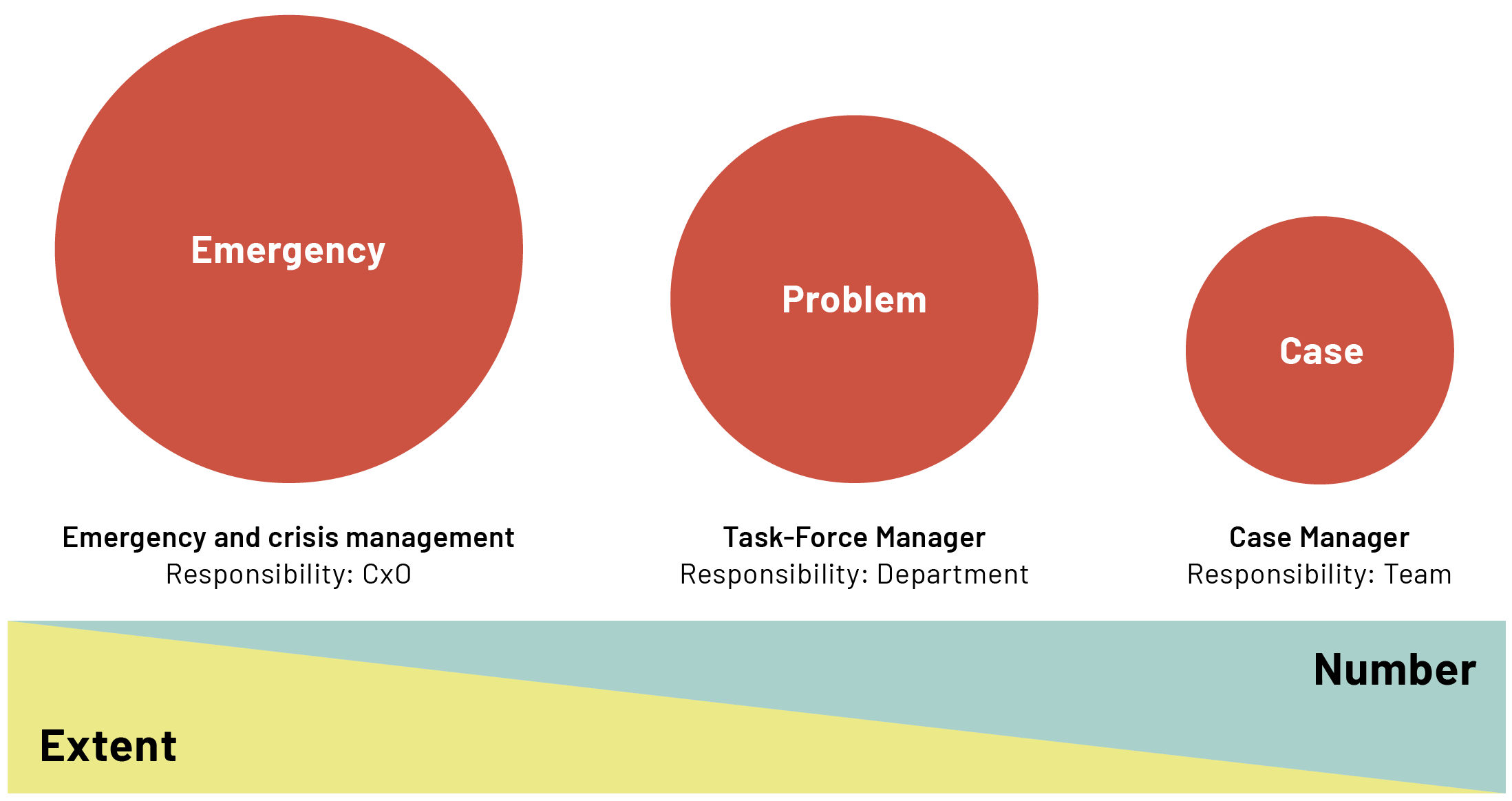
The figure illustrates the relationship between the three different fields of application: emergencies, problems and incidents. While emergencies are rare and problems and incidents clearly outnumber incidents, the opposite is true for magnitude. A single emergency can plunge the organisation into an existential crisis, while many small incidents usually do not have serious consequences for the company.
The impact of an emergency is always potentially dangerous to the organisation, as disruption of critical business processes, compromised personal safety, or reputational damage may follow.
For serious but less critical problems, a task force is to be used. Task forces can also be a mere prevention or improvement effort, with no disruption to production or the like.
Incidents are non-critical disruptions that are usually easy to resolve.
Organisational scope of problem situations
1. Emergency: CxO
2. Problem: Department
3. Case: Team
Large companies or organisations
As the size of the organisation and the scale of the incident increases, so does the complexity. Therefore, PULPIUS for emergencies is of particular interest to larger organisations. In order to increase efficiency in managing incidents in general, and thus provide real resilience and serenity, the same system must be used for more frequent occasions, at least at the departmental level.
Medium-sized and smaller organisational units (=department and team level)
Incidents within medium and smaller organisations or companies are easier to manage, especially in terms of organisational structures. If the incident is serious enough and therefore requires a dedicated group of people, it will be managed by a task force team (department level). But if it is low impact or the resolution of the incident is part of a service, the case manager is the right tool (team level).
About PULPIUS
How it all began
PULPIUS was born from a simple observation: in critical situations, organizations are often not lacking information—but clarity and leadership. This insight emerged in 2016 during the implementation of an emergency communication solution in a hospital. It quickly became clear that existing tools were too complex, too fragmented, or not designed for true crisis situations. From this, PULPIUS evolved into a platform that addresses exactly this gap: clear, integrated, and designed to keep organizations operational even under pressure.
The name PULPIUS
The name is inspired by the octopus—a creature that maintains control even in complex and turbulent environments. That is exactly what PULPIUS stands for: orientation and operational clarity, even when many things are happening at once.
The Founder

Daniel Eisenring
Daniel Eisenring thinks ahead and remains solution-oriented, even in demanding situations. When he believes in an idea, he pursues new paths—with a clear plan and a realistic view of risk.
He has experienced firsthand what happens when systems fail, time is limited, and decisions must be made under pressure—both in international banking environments and in critical public sector projects. These experiences shape his approach: leadership must work when uncertainty is at its highest.
Today, he translates this experience into PULPIUS—helping organizations gain clarity faster, make better decisions, and stay operational in critical situations.